
Social Learning Systems at Scale
Consulting
My work is grounded in social learning: the way meaning and possibilities for action develop when people participate in communities of practice over time.
My consulting practice rests on three connected pillars that protect long-term work while meeting contextual expectations.
LONG-TERM SOCIAL LEARNING PARTNERSHIPS
I engage in a small number of long-term partnerships with those responsible for sustaining social learning. Through ongoing joint sensemaking, I attend to what is emerging in practice and what is truly at stake. Periodically, we attend to value creation—not as measurement, but as language that protects work still in progress and can travel within organizations, leadership, or funder dialogues.
Timeframe: 6–12 meetings over 6–12 months
CONVENING AND FACILITATION
I occasionally convene and facilitate gatherings within longer social learning processes. These create moments of clarity about practice, relationships, and responsibility without closing the process. Insights are captured lightly and fed back into the ongoing partnership.
Timeframe: 1–3 days, including preparation and follow-up
DEVELOPMENT- AND LEARNING-ORIENTED EVALUATION
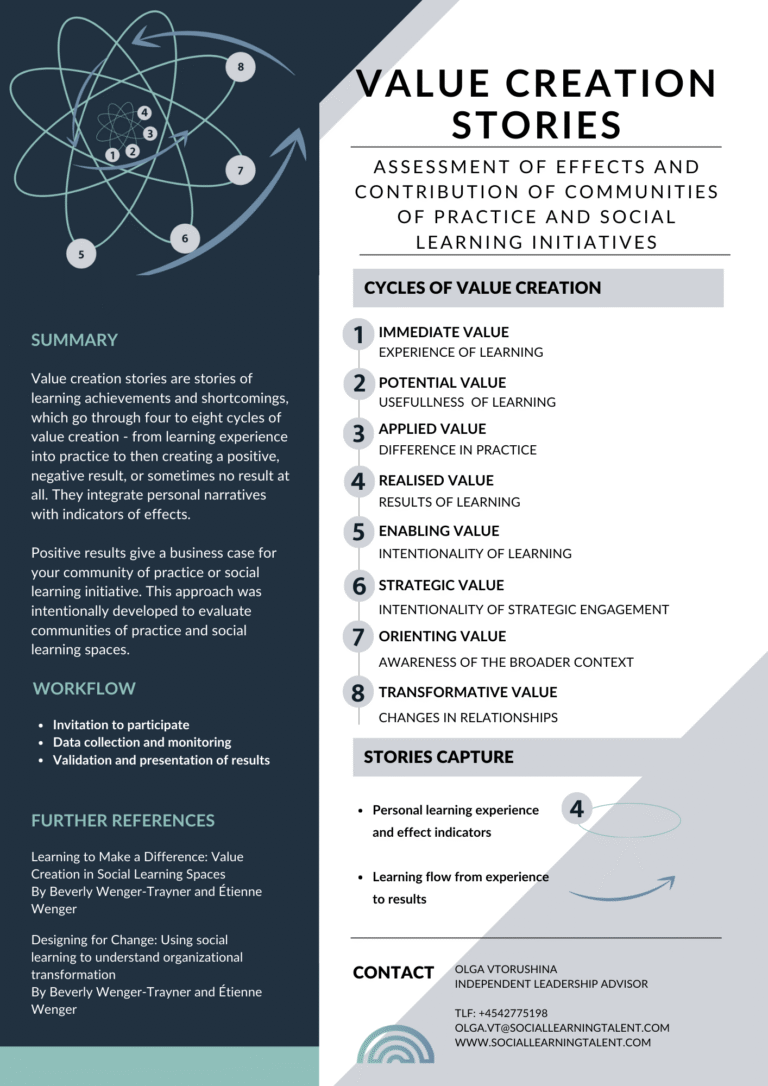
Where explicit learning and documentation are required, I work with developmental, learning-oriented evaluation of social learning and system initiatives. This allows value stories and reports to exist while keeping long-term partnerships relational and open. I do not take on evaluations that demand premature proof, simplification, or justification of decisions already made.
Timeframe: 3–6 months
The flow
The flow can start anywhere along the three main pillars
LONG-TERM SOCIAL LEARNING PARTNERSHIPS
CONVENING AND FACILITATION OF SOCIAL LEARNING PROCESSES
DEVELOPMENT- AND LEARNING-ORIENTED EVALUATION
FAQ
I typically engage in long-term consultancy agreements – 12 months at a time, with varying use of my time. All three pillars require more hours, that sponsor sparring only.
You are very welcome to get in touch at any time, when learning and knowledge exchange across organisational units and silos seem to fail.
Experience shows that you will get most out of it when
- your strategic and organizational goals are well established
- you have defined how you want to achieve your goals and have taken organizational decisions to support communities of practice, networks or social learning initiatives.
Ready to explore?
Enter content here. Lorem ipsum dolor sit amet, consectetur adipiscing elit. Ut elit tellus, luctus nec ullamcorper mattis, pulvinar dapibus leo. Lorem ipsum dolor sit amet, consectetur adipiscing elit. Ut elit tellus, luctus nec ullamcorper mattis, pulvinar dapibus leo.